Showing posts with label rainfall. Show all posts

Tuesday, 29 December 2015

Solutions: Rainwater Harvesting

I have already explored some solutions (drip irrigation, mulches, contour hedgerows etc.) surrounding inefficient water use. I am now looking at a solution not just for inefficient water use in agriculture but for lack of water.
Rainwater harvesting is the collection of rainwater for reuse in the domestic, agricultural or industrial sectors rather than letting it runoff and be wasted.

Rainwater harvesting has been around since the third century BC where it was used for irrigation in Tamil Nadu (India) but it has great potential within the African continent.
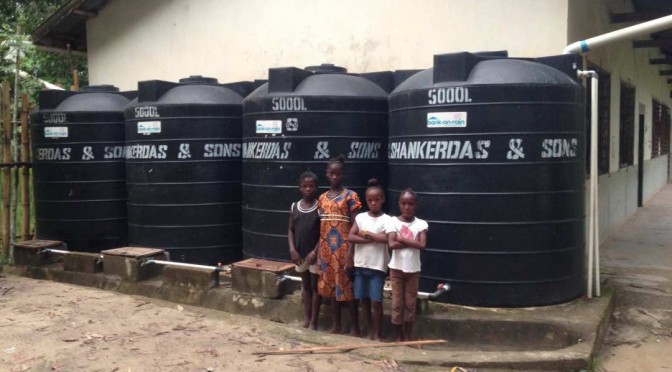
Rainwater harvesting in Africa (Source)

In a continent of highly variable rainfall and frequent droughts leading low productivity and food insecurity rainwater harvesting is a way of storing water during times of rainfall that can then be used when there is none. It is particularly useful for rainfed systems which are dependent on the natural variability of rainfall (Karpouzoglu and Barron 2014). Having this water available is a solution to food security and makes water use and crop production more productive and efficient (Dile et al 2013; Mwenge and Taigbenu 2011; Karpouzoglu and Barron 2014). Furthermore, rainfall patterns are the main factor effecting crop production in Africa (Muller et al. 2011) and with climate change creating extreme droughts and shorter wet seasons rainwater harvesting is seen as a major form of adaptation against climate change (Lebel et al. 2015).

However, as Getnet and Macalister (2012) note (as does Mwenge and Taigbenu 2011)the research and focus of rainwater harvesting has mainly been on domestic use such as Ward et al's (2012) study into rainwater harvesting in an office block. Rainwater harvesting may be low cost and simple technology but it requires high labour input to set up (Van Heerden et al. 2005). In poor rural communities they must rely on local (hopefully free) labour otherwise this low cost endeavour would be undermined if labour costs exceeded the cost of buying it.

Rainwater harvesting, like drip irrigation, is incredibly useful in the African continent - especially within agriculture because it is low cost but unlike drip irrigation it is easy to maintain and useful for all portions of society (as it can be used domestically as well). Used in conjunction with drip irrigation it could boost crop productivity in Africa.

Monday, 2 November 2015

Solutions to the Inefficient Use of Water in Agricuture

Water is wasted in agriculture. Previous blog posts have already explored this issue and examined the solution of drip irrigation.

In this blog post a range of solutions to inefficiencies in water use within agriculture will be critically examined in the extensive academic literature.
One of the most interesting articles which didn’t just focus on agriculture, came from Abdul-Rahmann et al. (2011) which in summary talked about using water from fisheries to irrigate agricultural land. The use of this water means that water is not wasted and that the water would contain natural fertilizer (from fish excrement). Although this research was not focused on Africa, it is an interesting idea to integrate two different types of agriculture (fish farming and arable farming). However, to be critical not all countries (in Africa) would have developed “modern” fisheries, such as the ones described in the article, that can capture the water and use it for irrigation and a project of this nature (as the article mentions) would be expensive. Landlocked African countries such as Zambia may not be able to afford this or have enough fish farms to make this a viable option.
Small scale fishing in Tanzania (Sand and Land)
Increasing efficiencies in agriculture does not just come in the form of the technology but also in the form of low cost strategies. 
Furthermore, there are other factors that need to be considered as illustrated in Wallace’s (2000) article. The relief and gradient of agricultural land plays an important role in determining the efficiency of water use within both irrigated and non-irrigated farming. Where land is steep surface runoff is high and infiltration into the soil is reduced (so water is not used for plant growth). Runoff of this kind is made up of 25-30% of rainfall in Niger (Rockstrom 1997) and up to 40% in Mali (Stroosnijder and Hoogmeed 1984). It is clear from these studies that reducing the amount of water occurring as surface runoff is important. Extensive work has been done by Lal (1989 and 1991) into such strategies to stop runoff. Adding materials to the land surface such as leaving crop residues or contour hedgerows can reduce runoff by capturing the water and are low cost and accessible to small scale African farmers. Wallace praises the use of mulches to reduce runoff but other studies have suggested that the use of mulches reduce direct soil evaporation (Barros and Hanks 1993). The effects of mulches, and their usefulness, will therefore vary depending on its relative influence on evaporation and infiltration. This would vary with frequency and quantity of rainfall.
Natural and environmentally beneficial, mulches are useful within agriculture (source)
Wallace’s article is extensive in its discussion of inefficiencies in water use within agriculture and provides solutions to problems that I had not considered – I seemed to focus my thoughts on “hard” engineering technologies but clearly low cost solutions such as mulches can be just as effective (and more accessible for small scale farmers).


Inefficiencies in water use within agriculture are huge and the literature and research into them and solutions is even greater and thus future blog posts will continue to explore this issue. 

*please note that Lal 1991 is only available in book form as is Rockstrom 1997.